Author: Kozo

  • What was Tsubamegun?

    In early 2008, Christopher Pellegrini, Dave Watkins, and Garrett DeOrio got together and decided to start this website. Chris and Garrett had dabbled in NPB coverage as part of Garrett’s Trans-Pacific Radio site. But getting Dave and his passion onboard was what lead them to decide to launch a standalone site. The site was launched with the hope that it would one day become an English one-stop-shop for all things Swallows past and present, and be one of many websites in an unified network of NPB team blogs.

    On June 5, 2008, Garrett posted the first post on Tsubamegun. The next day, Chris posted the first of 1,624 game reports that covered every regular season and playoff game played by the Swallows until the end of the 2017 season. (And full coverage of Japan in the 2009 World Baseball Classic for good measure.) These game reports became the backbone of our site and persisted while other projects were started and abandoned. In the early days of the site, before the mass proliferation of smartphones and HD video available everywhere, Tsubamegun game reports with its blatant bias and obvious love for the team were one of the few ways people could follow the Swallows in English. To our knowledge, no English NPB fan site has ever come close to replicating the comprehensiveness of our game report archive. This project was possible because Tsubamegun has always been a team effort. Chris, Dave, and Garrett wrote the reports for 2008 and 2009. Kozo Ota joined the team in early 2010. Scott Cavanaugh wrote reports from 2011 to 2013 until work took him out of Japan. Dan Yoshimoto joined the team in 2015 and Matt Schley wrote reports in 2017. Even with six writers writing reports in 2017, the game reports were starting to become a burden. With age came more personal and professional responsibilities, and the demand for written game reports diminished with the easy availability of HD highlights on Youtube. After the 2017 season we all agreed that writing game reports were becoming a chore and affecting our ability to enjoy baseball.

    After the game reports, our second longest running project was the Tokyo Swallows Podcast. Chris and Dave had done some baseball podcast episodes on Trans-Pacific Radio, before podcasts were cool. But the first Tokyo Swallows Podcast was launched on August 1, 2011 and has been recorded mostly monthly during the season since. Kozo inserted himself in the equation in 2013 and the trio ultimately released 71 episodes. Kozo and Dan started a spinoff podcast with the After Hours label that lasted 6 episodes. We enjoyed creating podcasts with the sass and attitude built up from over a decade of watching the Swallows.

    In the age of social media, the most regularly updated Tsubamegun property was our Twitter account which can still be found at @tokyoswallows. Dave and Kozo tried to keep up with the various Swallows goings on and in the absence of game reports made sure there were summary Tweets for each game through 2022.

    In spring 2023 we realized the site was down and we had lost our content. We’ve managed to save the domain and we’ll use this space to bring back some of our greatest hits. Thanks to the Internet Archive a lot of the site is still available. You may have noticed that many of the preceding links are from the Wayback Machine.

    While the site never quite lived up to its initial lofty goals, we’re proud of what we’ve accomplished. We’re still passionate about the Swallows and we hope to continue to share our passion as best we can. Thanks to everyone who followed us, and hope the site brought something positive to your life.

  • Tokyo Swallows Podcast 72 (October, 2022)

    This episode of the podcast was never actually released on the website/feed. It was recorded shortly after the Swallows’ clinched their back-to-back CL pennant and they were waiting for their Climax Series opponent. When we tried to post the episode on the website we ran into some issues that we ultimately never figured out before we completely lost the site. We did share the file via Twitter on October 10, 2022.

    Take a trip down memory lane and listen to 2022 Dave, Chris, and Kozo relive the Swallows’ September and October including the team’s pennant winning game.

    Play the episode

    Fediverse Reactions
  • Tokyo Swallows Podcast 41 (September, 2017)

    Dave, Chris, and Kozo come off of their summer vacations to discuss the state of the Swallows. Topics covered include:

    • Dave confuses the boys about the lineage of number 41
    • CL standing overview
    • How bad is this season historically?
    • Manaka and the manager situation
    • Kawabata injury update
    • Coco and his future with the team
    • Memorable games in 2017
    • The Sugiura-Yagi trade
    • The state of the rotation
    • The Yamada update
    • Jingu attendance situation
    • Retirement speculation

    Recorded prior to the game on Sunday September 3, 2017.

    At the end of the podcast we pay tribute to friend of Tsubamegun, Toshiyuki “Take-chan” Takeo who passed away suddenly at the too young age of 37. Take-chan was Dave’s bandmate for over 10 years and while he wasn’t the biggest baseball fan but his kind heart touched all of us and we wanted to do something to honor his memory. Take-chan was an accomplished guitar player and we ended the podcast with a track that featured Take-chan’s guitar work, Rapture.

    You can download a higher quality version of the track here.

    We’ll miss you Take-chan! The world is a colder place without you in it but you’ll live on in our memories and through your music.

    Toshiyuki Takeo (1979-2017)
    Toshiyuki Takeo (1979-2017)
    Play the episode

  • How Does the NPB Draft Work?

    With the 2010 NPB Draft fast approaching, Tsubamegun will be presenting a number of articles filling you in on how the draft works and which players the Swallows may be eying. Part 1 of this series will explain the mechanics of the NPB draft.

    The 2010 NPB draft will be held on October 28 at the Grand Prince Hotel New Takanawa in Tokyo. For those of you who are used to draft systems used in North American sports, the NPB draft has a number of wrinkles that you may not be familiar with. This post will walk you through the minutia of the draft.

    Eligibility: Broadly speaking, the draft applies to, any Japanese citizen, or non-Japanese persons educated at a Japanese educational institution or who has spent at least 3 years playing semi-pro ball, who has never signed with an NPB team. Although there are a number of other restrictions that limit the pool considerably.

    For students currently enrolled in school, they must be on track to graduate in the March proceeding the draft. Furthermore, university students must be in their fourth year of study or above. Students who drop out from their school after April 1st on the year of the draft are not eligible to be drafted that year. Finally, students must submit letters of intent to their respective governing organizations to be eligible for the draft. High school students must submit their letter to the Japan High School Baseball Federation, while university students must submit their letter to the Japan University Baseball Federation.

    The draft eligibility of players playing in leagues associated with the Japan Amateur Baseball Association, commonly referred to as the industrial leagues, depend on time served with their current club. Players that joined industrial league teams straight out of middle or high school, are not eligible to be drafted until they play 3 years with that club. All other players, like journeymen industrial leaguers, cannot be drafted until they play 2 years with their current club. Players from teams that fold or go on hiatus are exempted from these rules.

    All other players, like those playing in independent leagues, are eligible to be drafted as long as they fit into the broad eligibility rules outlined in the beginning of this section. In terms of non-Japanese people, if you’re drafted by an NPB team you do not count towards the import quota.

    Selections: The first round of the draft is based on a simultaneous bid system. All 12 teams declare the player they wish to select with their first selection. The negotiation rights to players that are named by only 1 team, go to the team that selected them. The rights to players that are named by multiple teams are decided by random draw. Teams that lose out on the draw must name another available player, and the process repeats itself until all 12 teams have selected a player. Hideo Nomo and Hideo Koike share the record for being named by the most teams with their the first selection, with 8 teams vying for their services.

    All subsequent rounds carry on through a snaking draft order. In other words, the draft order alternates between regular and reverse order. The draft order for the first such round starts with the last place team from one of the leagues, followed by the last place team from the other league, followed by the fifth place team from the first league, etc. The league which selects first is determined through on the results of that year’s All Star game. This year, the Central league team will select first in the second round.

    Teams do not have a set number of draft picks, and may stop picking once they determine that they do not want any other available player. The draft ends when all teams have stopped making selections, or when 120 total players have been selected, whichever happens first.

    Negotiation Rights: Once teams have selected players, they have until the end of March of the next year to sign them to a pro contract. Industrial team players only have until the end of January to sign a contract. Players that fail to sign with a team will be eligible to be drafted in the future, provided they meet the eligibility requirements.

    That wraps up our quick and dry look at the draft process here in Japan! Stay tuned for some of the big names that will be on everyone’s radar come Thursday.

  • Remembering Masayasu Okada

    Today (July 30) marks the eighth anniversary of the passing of Masayasu Okada, arguably the Swallows’ biggest fan. Okada was responsible for many of the cheering rituals that continue to be used to this day, including the use of umbrellas and the singing of Tokyo Ondo. Beyond an obituary written by Jim Allen and some mentions in Robert Whiting’s You Gotta Have Wa, not much has been written about Okada in the English language. While the proceeding will not be able to do justice to Okada’s life and contribution to the Swallows, I do hope they give the reader some insight into how one man so greatly influenced the identity of our beloved team.

    Masayasu Okada, born April 8 1931, was a working class Tokyo-ite. A young Okada was first exposed to Swallows baseball in 1952, when he attended a Giants-Swallows game at Korakuen stadium. What Okada saw was stands dominated by Giants fans. Feeling sorry for the Swallows, Okada decided to cheer for the team. That day in 1952 was the beginning of a special relationship that ran through the rest of Okada’s life.

    While Swallows fans today are still greatly outnumbered by Giants fans, it’s important to remember that in 1952 the gap was much wider. The Swallows, still in their formative years, were barely managing to attract double digit fans into their cheering section. In order to be heard, Okada began beating a frying pan while cheering. The frying pan was one of many home-made cheering innovations brought about by Okada. It is said that Okada was the first fan to popularize the use of megaphones in baseball cheering when he brought a modified traffic cone, painted in Swallows colors, to the stands.

    Despite the Swallows perennial B class finishes, the Swallows cheering section began to grow in large part to Okada’s quirky style and passion. Still outnumbered, however, Okada suggested that fans should bring umbrellas from home to make it look like there were more fans in the stands. That tradition lives on today, combined with another Okada suggestion, the singing of Tokyo Ondo. In 1978, as the Swallows finally found success, Okada suggested that Swallows fans begin singing Tokyo Ondo as it was a song that every Tokyo-ite would know. Swallows fans new and old were able to come together to sing a common anthem. Even as the number of fans increased Okada was never drowned out, as he simply exhibited even more passion in leading the crowd in cheer.

    Okada’s continued loyalty was finally rewarded on October 4, 1978 at Jingu Stadium, when the Swallows beat the Chunichi Dragons to capture their first Central League pennant. After over a quarter-century of cheering on the Swallows, the team had finally won a pennant. When the Swallows were presented with the champions’ trophy, the Swallows’ Katsuo Ohsugi invited Okada to join the players in parading the trophy in front of the fans. When manager Tatsuro Hirooka gave the winning address to the fans, Okada was at his side. When the Swallows won the Nippon Series a few weeks later, the scene of Okada crying in the stand was broadcast to the nation.

    Okada continued to be a regular supporter of the Swallows right up to his death in 2002. Just one week prior to his passing, Okada had traveled to Hokkaido to cheer on the Swallows. In all Okada had attended over 3800 Swallows games, and was a part of Swallows baseball for a long time. Okada was true fan that cheered for the team through good times and bad, and loved the players and the fans like family. Okada’s cheering philosophy was to make sure the fans had a good time so their positive energy would rub off onto the players. Though he may no longer be in the stands, his impact on Swallows baseball, and Japanese baseball as a whole are still felt today.

    A memorial set up in right field shortly after Okada’s passing. Note the frying pan and traffic cone megaphone.
  • A Baseball Journey from Montreal to Tokyo

    My Road to Becoming a Swallows Fan

    Howdy Tsubamegun readers! My name is Kozo Ota, and I was recently asked to become a contributor to this fine site. As a fan of both the Swallows, and this site, it took me all of 5 seconds to accept the offer. I hope to contribute posts that provide further information about the team, and about Japanese baseball. But I thought my first post should be about myself, in order to lay out my bona fides, and to tell my story about how I came to be a Swallows fan. In the simplest terms, I am a third-generation Swallows fan. My maternal grandfather was a Swallows fan, back from a time they were the Kokutetsu Swallows. Most of his children became Swallows fans. So it would only seem natural that I would become a Swallows fan, but my story is a bit more complicated than that.

    I was born and raised in Montreal. So while I was exposed to the Swallows through my relatives when I visited Japan every summer, I did not feel any strong connection to them. I was, however, a big Montreal Expo fan. I started following the Montreal Expos in 1994 as part of an elementary school math unit. Those of you who know anything about Major League Baseball history know that the 1994 season was shortened by a labor stoppage, and that the World Series was canceled. What is perhaps not as well remembered is that the 1994 Expos, through the play of players like Larry Walker, Moises Alou, and a young Pedro Martinez, accumulated the best record in baseball and seemed destined for the World Series. However instead of building on that strong nucleus of talent, management conducted a fire sale after the season, parting with many of the team’s star players. The 1994 season is seen as the beginning of the end of the Montreal Expos. All of this is to say, I picked the absolute worst time to start following the Expos.

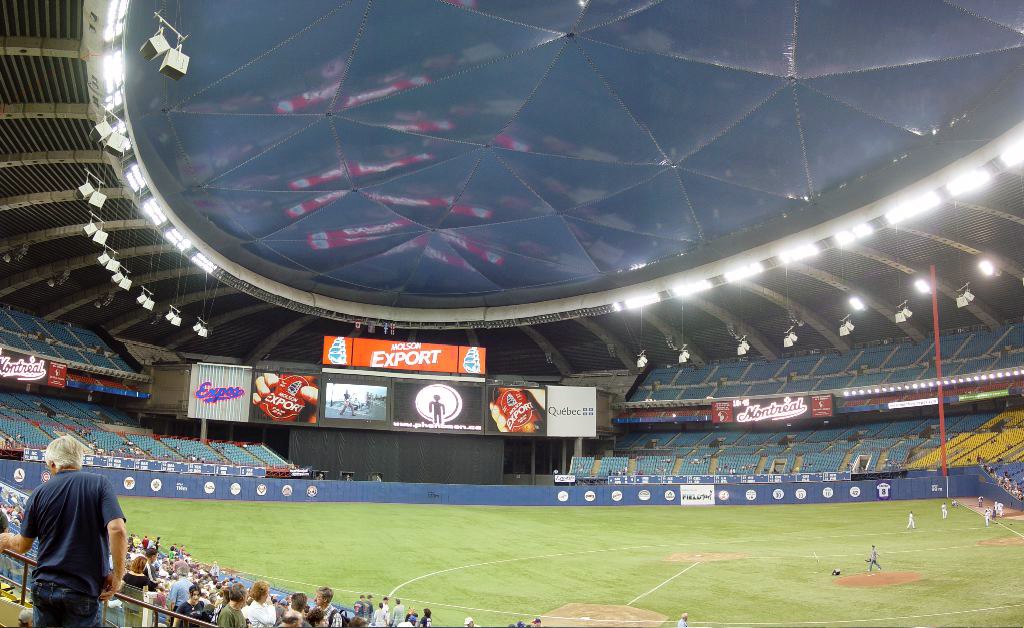
    By the time I was allowed to go out on my own, I went to the cavernous Stade Olympique every chance I could. In a town where baseball was the sport that you watched while you waited for the hockey season to start, I was a very rare breed, a young diehard baseball fan. Over the years, I got to see some great baseball, but I also felt the agony of bad management and ownership conspiring to keep my team down. I learned a lot about baseball, and the management decisions that work behind the game. These qualities that will no doubt serve me well as a Swallows fan. My emotional investment in baseball ended in fall 2004, when both the Expos and I left Montreal. The Expos moved to Washington and became the Nationals, while I moved to Hamilton, Ontario to study at McMaster University.

    The interior of Olympic Stadium in Montreal taken in 2006
    Where I used to go watch baseball games. Tolivero, CC BY-SA 3.0, via Wikimedia Commons

    Relieved of the burden of living and dying at the performance of a single baseball team, I was able to become a more objective observer of baseball. I attended a few Toronto Blue Jays games in Toronto, watched the WBC on TV, and even took in a few Japanese games when I visited Japan. I always enjoyed the atmosphere at Japanese baseball games , especially when contrasted against the hollow deadness that I had come to associate with Expos games at the Big O. I also felt a great appreciation for the small ball play that was found in NPB. I knew if ever I were to come live in Japan, I would let myself be taken in by baseball again.

    So when I moved to Japan last summer, I quickly got around to getting myself back deeply into baseball. I briefly flirted with the idea of switching my “natural” allegiance of the Swallows to another team, but I couldn’t find any good reason to make a switch. The Swallows play in a nice outdoor park (the kind Expo fans were promised in 2000), the Swallows were not an unlovable juggernaut, and quite frankly I had no good reason to disappoint my relatives. I eased myself into the state of the Swallows, watching games on TV with my uncle and reading up on players. My first, and only, Jingu game of the season was the October 9th game where the Swallows punched their ticket to the Climax Series. I knew I had made the right choice and vowed to be back more often next season. Now, you can regularly find me in the right field bleacher seats at Jingu shouting cheers at the top of my lungs, and commiserating with fellow Tsubamengun contributors and their friends.

    I hope to share the insights I gain as I become more informed about Japanese baseball, while also providing unique analysis that comes from my exposure to Swallows lore, and Major League Baseball.

    Where I go now.